
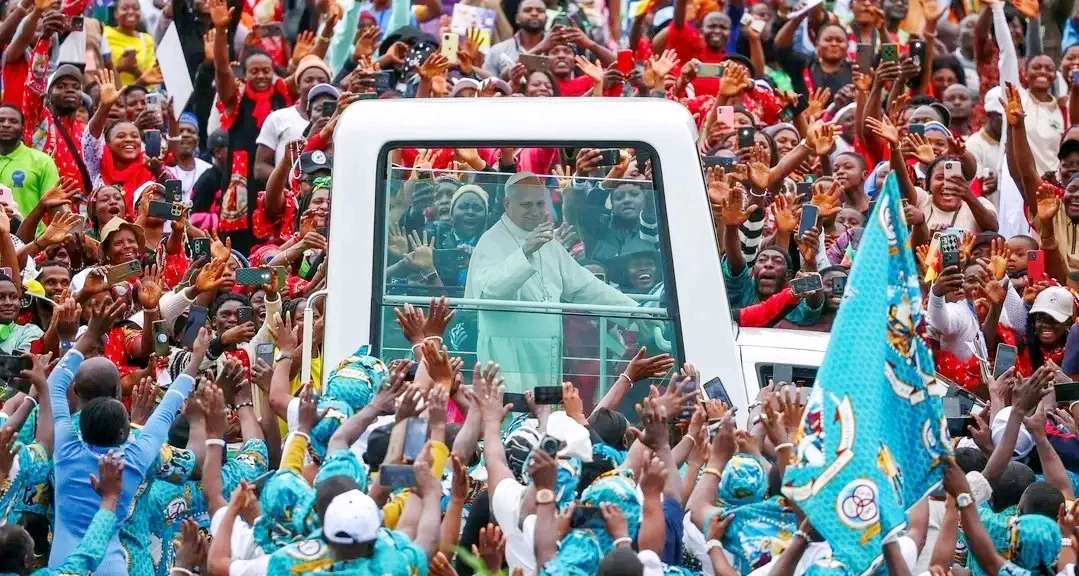
In a country of about 29 million people, not only the eight million Catholics were eager to receive Pope Leo, the Universal Church leader.
At Cameroon’s presidential palace in the capital Yaoundé, Pope Leo said he was a servant of peace. However, millions of Cameroonians saw him beyond that. To many, Leo is hope, a father figure who speaks truth to power—and he did.
The Central African nation has issues on many fronts: the 10-year armed conflict in western regions, the Boko Haram insurgency in the Far North, the rebel crisis in the east, and the political divide—an offshoot of the 2018 and 2025 presidential elections.
Those challenges, according to His Holiness, “are causing profound suffering” to the population. He was equally blunt about corruption, whose chains, he said, need to be broken for justice and peace to prevail.
Beyond championing peace, which he said “can’t be decreed,” Pope Leo stood in the embattled Bamenda, Northwest region, and also challenged “tyrants” who caused wars to profit from them. His messages were tailored to suit the daily challenges faced by millions. In Douala, the economic capital, he beckoned young people to resist the temptations of violence and immigration.
Many Received Pope Leo’s Messages with Hope
The Holy Pontiff took leaders to task. His speeches were void of diplomatic interpretations. His messages, some say, were timely, especially as many had lost hope.
In Bamenda, Bishop Andrew Nkea of the city’s Archdiocese told His Holiness that his presence on Northwest soil was a sign of consolation. It was relieving for many who have been affected by the conflict that has killed at least 6,000 and displaced millions. The Iman of Buea Central Mosque in Southwest Cameroon said the Pope’s voice on issues in Anglophone Cameroon carries weight.
“Holy Father, Cameroon has been through a lot of difficulties since the beginning of what is now popularly known as the Anglophone crisis,” the Fon of Mankon, Fru Asaah Angwafor IV, representing Northwest and Southwest traditional rulers, said. They were confident that Pope Leo’s presence would “help bring peace to the suffering regions.”
The manner in which the clergy painted the atrocities the region has undergone clearly demonstrated the desire for peace.
Cameroonian bishops against same-sex marriages.
It appears that, other than peace and the need for good governance, many were not ready for another thing. While the Supreme Pontiff hammered the country’s issues, there are underlying and deeper problems affecting his church in particular, which he never commented on.
His predecessor, Francis, had disagreements with the flock in Africa regarding conservative family values.
In 2023, the Cameroon National Episcopal Conference, a grouping of bishops, vehemently rejected the late Pope Francis’s proposal—blessing same-sex marriages.
“In Africa, we understand marriage as the union between a man and woman, and anything outside of that is witchcraft,” said Bishop Andrew Nkea, President of the National Episcopal Conference.
Aside from the bishops’ stance, Cameroon’s penal code penalizes it under Section 347-1 with imprisonment of five years and a fine of over 200,000 FCFA.
Since taking office, Leo has not publicly commented on the issue, and his position on it remains unknown.
Growing concerns about polygamy in church
Apart from the same-sex issues that Cameroonian bishops are against, polygamy is also taking deep root among African Catholics, particularly in Cameroon. Pope Leo leads a church that recognizes only monogamy, but African bishops understand the context and are lenient toward children who come from polygamous marriages.
On March 25 this year, African Catholic Bishops meeting in Kenya published a 25-page report addressing pastoral challenges on polygamy, among other issues.
According to the report, the African family is built on a covenant: an alliance between human groups, an alliance with ancestors, and an alliance with God. They say such practices are common in Africa, defending that polygamy is practiced not only for the sake of large families but also for reasons of solidarity and political objectives.
However, their position remained clear: “Baptizing a polygamist who will continue to remain so would give every appearance of legitimizing this irregularity and could distort or even devalue the substance of baptism.”
Issue of Priests marrying
Again, there is the aspect of allowing priests to marry. There have been increasing reports of Catholic Church leaders having sexual affairs. In the past, many have raised the issue, suggesting priests should be allowed to marry than sin in sexuality.
The Associated Press in 2019 carried an investigation that found that 1,700 priests and other clergy within the Catholic Church had been accused of sexual abuse. Another report indicated that one in every 10 priests was in an illicit relationship. However, a debate remains within the church over whether marriage should be legalized for the clergy.
In as much as the Holy Pontiff was not bluffing when he called for peace, deep within the Catholic Church, these issues he never mentions are seeking redress.
